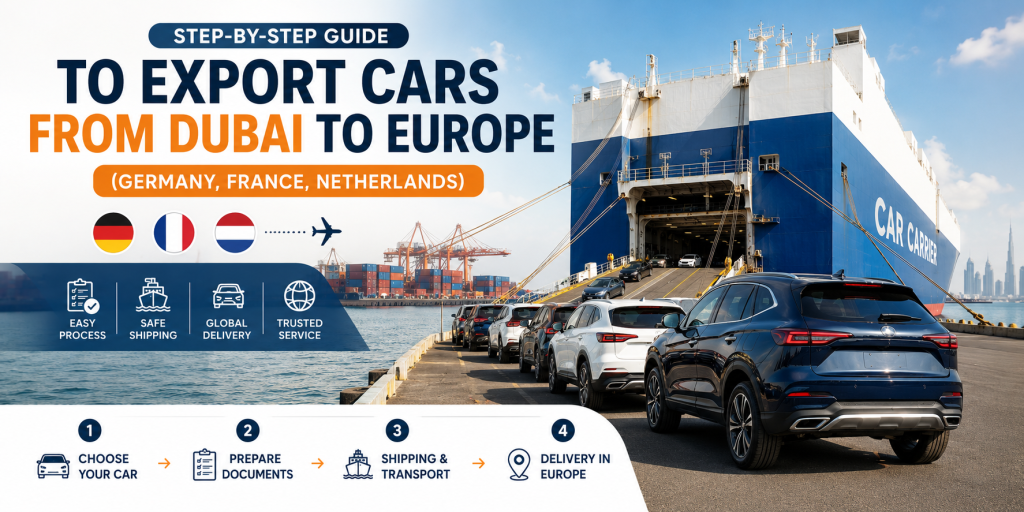
Exporting cars from Dubai to Europe—especially countries like Germany, France, and the Netherlands—has become a highly profitable business opportunity. Thanks to Dubai’s tax-free automotive market, wide vehicle selection, and competitive pricing, many European buyers prefer sourcing vehicles from the UAE.
However, exporting a vehicle is not just about buying and shipping—it involves legal compliance, documentation, logistics, and European import regulations. This guide explains the complete process step-by-step.
Why Export Cars from Dubai to Europe?
Dubai is one of the world’s leading automotive export hubs. Here’s why:
- Competitive vehicle prices (often 20–40% cheaper than Europe)
- Wide availability of luxury and low-mileage cars
- Tax-free environment (no VAT on exports)
- Strong logistics infrastructure (ports like Jebel Ali)
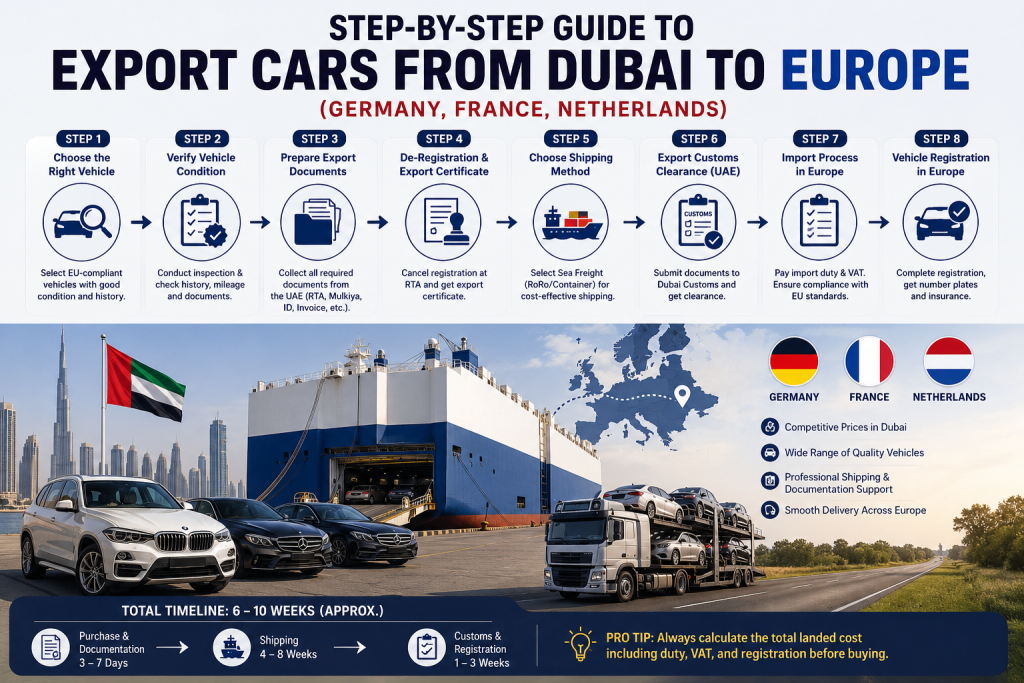
Step 1: Choose the Right Vehicle
Before exporting, ensure the car meets European standards:
- Left-hand drive (mandatory in most EU countries)
- Acceptable emission standards (Euro 5 / Euro 6)
- Clean accident and ownership history
- Prefer European brands (BMW, Mercedes, Audi) for easier registration
💡 Tip: Not all UAE-spec cars meet EU regulations, so always verify compliance first.
Step 2: Verify Vehicle Condition & Inspection
Conduct a professional inspection before purchase:
- Mechanical condition
- Accident history
- Mileage verification
- Service records
Many exporters provide detailed inspection reports with photos and videos.
Step 3: Gather Required Export Documents (UAE Side)
To legally export a vehicle from Dubai, you need:
- Original vehicle registration card (Mulkiya)
- Passport & Emirates ID copy
- Export certificate from RTA
- Clearance of fines/loans
- Purchase invoice or sale agreement
- Export insurance
- Customs clearance certificate
👉 The RTA export certificate is essential—it confirms the car is deregistered and ready for export.
Step 4: De-Registration & Export Certificate
You must:
- Cancel vehicle registration at RTA
- Return number plates
- Clear all fines and loans
After this, the vehicle is officially marked for export and cannot be used in the UAE.
Step 5: Choose Shipping Method
There are three main shipping options:
1. Sea Freight (Most Common)
- Cheapest and widely used
- Options: Container shipping or RoRo (Roll-on/Roll-off)
- Transit time: 4–8 weeks
2. Air Freight
- Fast but very expensive
- Used for luxury or urgent shipments
3. Land + Sea Combination
- Used in some European routes
Sea shipping is the most economical and preferred method.
Step 6: Export Customs Clearance (UAE)
Before shipment:
- Submit documents to Dubai Customs
- Obtain clearance certificate
- Vehicle is loaded at port (e.g., Jebel Ali)
At this stage, a Bill of Lading is issued by the shipping company.
Step 7: Import Process in Europe
Once the car arrives in Germany, France, or the Netherlands:
1. Customs Clearance
- Pay import duty (approx. 10%)
- Pay VAT (varies by country, usually 19–21%)
2. Technical Compliance (Homologation)
- Vehicle must meet EU safety & emission standards
- May require modifications
3. Certificate of Conformity (COC)
- Confirms vehicle meets EU regulations
- Required for registration in most EU countries
Step 8: Vehicle Registration in Europe
After compliance approval:
- Register vehicle with local authority
- Obtain number plates
- Purchase insurance
Each country (Germany, France, Netherlands) has slightly different procedures, but the overall process is similar.
Step 9: Total Cost Breakdown
Your final cost includes:
- Car purchase price (Dubai)
- Shipping charges
- Export documentation fees
- Import duty (~10%)
- VAT (19–21%)
- Registration & compliance costs
💡 Important: Cheap Dubai prices can be offset by European taxes—calculate carefully before buying
Step 10: Timeline
Typical export timeline:
- Vehicle purchase & documentation: 3–7 days
- Shipping: 4–8 weeks
- Customs + registration: 1–3 weeks
👉 Total time: 6–10 weeks
Key Challenges to Consider
- EU emission and safety standards
- Additional modification costs
- Complex paperwork
- Import taxes reducing profit margins
- Non-EU cars may require special approva
Pro Tips for Successful Export
- Always choose EU-compliant vehicles
- Work with experienced export agents
- Verify documents carefully
- Calculate total landed cost before purchase
- Prefer European brands for easy registration
Conclusion
Exporting cars from Dubai to Europe can be highly profitable if done correctly. While Dubai offers attractive prices and a wide selection of vehicles, success depends on understanding regulations, documentation, and logistics.
With proper planning, compliance, and the right partners, you can smoothly export vehicles to Germany, France, and the Netherlands—and build a sustainable international car business

Leave a Reply